
The Entrepreneur in Post Innovative Economy
Author’s course
The Innovative Economy is founded on the assumption that novelty is a value in itself, growth is synonymous with progress, and technology serves as the primary driver of development. This paradigm continues to shape the content of most entrepreneurship education programmes, from MBA curricula to startup accelerators.
The contemporary Post Innovative Economy, however, is built upon a different set of principles. Within this environment, successful entrepreneurial decisions are increasingly shaped by factors that extend beyond the boundaries of a purely business-oriented approach.

Context
In the Post Innovative Economy, novelty in itself no longer constitutes a competitive advantage, and economic growth is no longer regarded as a universal objective. The concept restores the human foundation of economic activity, positioning ethics and aesthetics as integral structural elements of entrepreneurship.
The programme is based on the authorial concept developed by Professor Ekaterina Litau, Doctor of Economics. Over the 12-week course, participants will re-evaluate their businesses through the lens of the Post Innovative Economy, identify new opportunities for the development of their ventures, and acquire the knowledge and practical tools required to design and create successful products.
Leading experts

EKATERINA LITAU
Doctor of Economics, Professor, author of the Post Innovative Economy concept and the Entrepreneurial Vitality model. Founder of BLCONS GROUP
(25+ years of market experience).
Leads the theoretical component of the programme.

SERGEY KHELMYANOV
Teacher, architect, and design theorist. He taught for over 20 years at the Stieglitz Academy, where he headed the industrial design department.
He has trained dozens of internationally renowned specialists, including in-house designers for many leading brands, from RENAULT to ASTON MARTIN.
Leads the practical component of the programme.

ILYA STAKHEEV
Director of Public Relations at BLCONS GROUP, PhD in Pedagogy, lecturer at HSE University and ITMO University, and creator of the educational initiative Total Dictation.
Translates philosophical concepts into practical solutions through authorial lectures and corporate programmes, and advises business leaders and public sector executives.
Leads the programme module dedicated to the philosophical foundations of entrepreneurship.
Questions addressed by the Programme
A growing sense that conventional business approaches and educational programmes have reached their limits, while no clear alternative has yet emerged.
Entrepreneurs recognise that traditional methods are becoming less effective, yet struggle to identify new frameworks for growth and development. The programme offers a contemporary perspective on development, helping participants navigate change and uncover new opportunities.
A disconnect between a company’s declared values and the decisions made in everyday practice.
Companies have long articulated their missions, brand values, and decision-making principles in official documents. Yet in practice, these aspirations often become little more than another set of KPIs — or, in the worst cases, are cynically disregarded. The programme offers an alternative perspective on entrepreneurship, one in which ethics and aesthetics serve as the fundamental foundation of a successful business venture.
The challenge of communicating one’s ethical position and maintaining confidence that a chosen course of action is both sound and relevant in today’s world.
Entrepreneurs who place importance on the ethical and aesthetic dimensions of business often find themselves questioning their own position and struggling to develop a language through which these ideas can be effectively communicated to investors, partners, and employees.
The absence of an environment in which strategic business questions can be discussed meaningfully with peers of a comparable level.
Most of business communities are built around the exchange of techniques or networking opportunities. The purpose of the programme is to facilitate the exchange of new knowledge and foster a progressive intellectual environment in which participants can explore questions of development, reflect on the purpose of their work and its broader human value, and build relationships with like-minded individuals seeking to move beyond financial efficiency towards a deeper understanding of the significance of entrepreneurial activity.

Who is this course for
The programme is designed for entrepreneurs and executives who are directly responsible for making strategic decisions. Participants include business owners, leaders of strategic functions within large organisations, and entrepreneurs. They are united by a shared ambition to create contemporary, values-driven projects.
Programme Structure

WEEK 1
POST INNOVATIVE ECONOMY: DEFINITION, CONCEPT, AND KEY CHALLENGES
Led by: Ekaterina Litau and Sergey Khelmyanov
The first session is dedicated to the concept of the Post Innovative Economy. Participants examine situations in which the traditional language of innovation, growth, and technological development no longer provides an adequate basis for effective decision-making. Ekaterina Litau introduces the concept of the Post Innovative Economy and presents economic activity as a process of unlocking human potential — engaging the full spectrum of an individual’s personal and social resources, rather than focusing solely on the pursuit of commercial objectives.
During the session, participants describe their own projects using the familiar language of business efficiency and analyse their limitations through the lens of the Post Innovative Economy concept. This perspective reflects their starting position and serves as a point of reference for further work throughout the programme. The session concludes with a discussion of participants’ questions, doubts, and objections, which the group will revisit over the course of the programme.
Outcome of the week: an initial description of the participant’s project and a clear understanding of the central question they bring to the programme.

In 1972, the Club of Rome published its landmark report, The Limits to Growth. Its mathematical model demonstrated that infinite economic growth within a finite biosphere is impossible. At the time, this idea was widely regarded as utopian. Today, however, the same issue is discussed at the level of governments, central banks, and major corporations.
These constraints have long since become part of entrepreneurial reality. One of the programme’s objectives is to help participants transform such limitations into new entrepreneurial opportunities.

WEEK 2
UNDERSTANDING THE POST INNOVATIVE POTENTIAL OF AN ENTREPRENEURIAL PROJECT
Led by: Ekaterina Litau
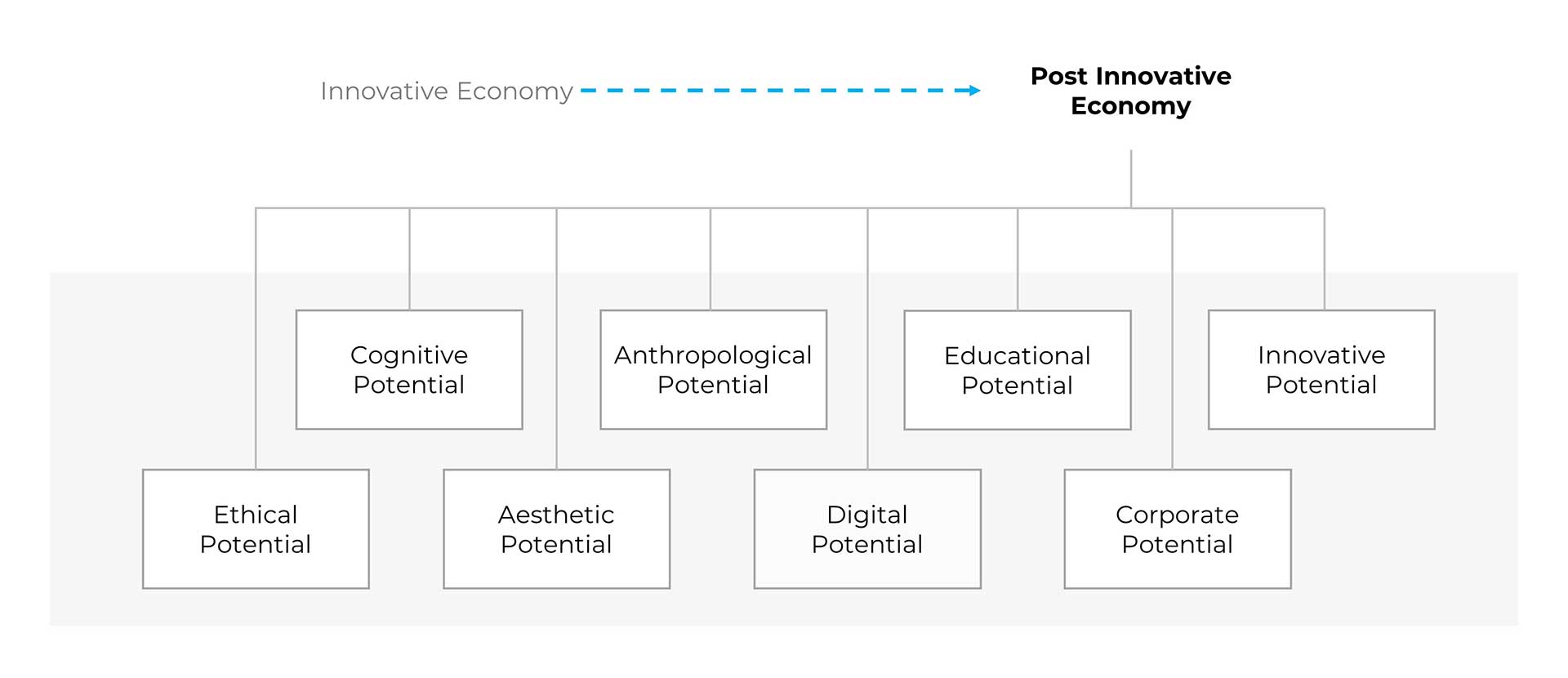
During the second week, participants examine their businesses as projects with multiple levels of development. The central concept is Post Innovative Potential — the set of qualities that enables a company to remain resilient, meaningful, and capable of renewal.
The session explores eight dimensions of Post Innovative Potential: cognitive, anthropological, educational, innovative, ethical, aesthetic, digital, and corporate. This framework helps participants identify which aspects of their business are already well developed and which require further attention and transformation.
Outcome of the week: a diagnostic assessment of the participant’s project and the identification of key areas requiring transformation.

WEEK 3
THE HUMAN BEING AT THE FOUNDATION OF BUSINESS
Led by: Ilya Stakheev
This session returns the discussion of entrepreneurship to a fundamental question: the human being. What does an entrepreneur actually create when building a business? What experience, vision of the future, type of relationship, or way of life does a project offer to others?
Participants explore entrepreneurship as a transformative activity. The discussion introduces key ideas from the philosophy of economic life, creativity, freedom, and the concept of the common good.
Outcome of the week: participants articulate the anthropological, cultural, and social foundations underlying their business projects.
Today, the space industry appears almost commonplace: GPS, satellite communications, and even discussions of the future colonisation of Mars have become part of everyday discourse. Yet before governments and investors were willing to support such ambitions, someone first had to articulate humanity’s expansion into space as a meaningful objective. In the nineteenth century, this task was undertaken by Nikolai Fyodorov, often described as the “Russian Socrates” and perhaps the most entrepreneurial of philosophers. He developed the concept of the Common Task, a vision that inspired generations of thinkers and innovators. Among the young people who attended his lectures in Moscow in the 1870s was Konstantin Tsiolkovsky.
Tsiolkovsky later influenced Sergei Korolev, whose work shaped the Soviet space programme and, indirectly, much of the American space effort as well. The market value of today’s private space companies can ultimately be traced back to ideas developed by a philosopher who, during his lifetime, received only a modest salary and published very little.

WEEK 4
AESTHETICS AS AN ECONOMIC CATEGORY
Led by: Ekaterina Litau
In business, aesthetics extends far beyond the creation of a product. It is reflected in the choice of form, the language of communication, the design of space, the quality of service, the rhythm of customer interaction, and the way a company presents itself to the world.
During this session, participants explore the concept of aesthetic added value, distinguish between style, taste, and fashion, examine the relationship between art and economic creativity, and discuss the characteristics of mature aesthetic solutions within entrepreneurial projects.
Outcome of the week: an aesthetic audit of the participant’s business, covering everything from the product and visual language to the overall customer experience.

The Eiffel Tower was built for the 1889 World’s Fair as a temporary structure. It was originally intended to be dismantled after twenty years. Many contemporaries considered it an eyesore, and according to a well-known story, Guy de Maupassant regularly dined in its restaurant because it was the only place in Paris from which he did not have to look at it. Today, it is impossible to imagine Paris without the Eiffel Tower. An aesthetic decision that was once widely regarded as unquestionably unattractive has, over time, become both a significant source of revenue for the French economy and one of the world’s most enduring symbols of romantic love.

WEEK 5
THE ETHICAL FRAMEWORK OF BUSINESS
Led by: Ekaterina Litau
Participants approach ethics as a practical framework for decision-making. The session explores key concepts of the Humanistic Theory of Entrepreneurship, including selfhood and the autonomy of the individual.
The concept of ethical added value is introduced and examined in depth. Participants analyse how a company’s culture, as well as the ethical beliefs of its leaders and employees, are reflected in everyday actions and influence the products and services it creates. The session also explores the concept of Projective Entrepreneurial Responsibility.
Outcome of the week: an analysis of real-world management practices through the lens of contemporary ethical principles.

WEEK 6
THE ENTREPRENEUR’S EMOTIONAL WELL-BEING IN THE CONTEXT OF THE POST INNOVATIVE ECONOMY
Led by: Ekaterina Litau
This session explores the cognitive demands placed on entrepreneurs, why emotional well-being has become a critical factor in business success, and how it influences the quality of decision-making.
Participants examine the limitations of attention, decision fatigue, the distribution of responsibility, and strategies for managing the complexity of entrepreneurial projects without experiencing internal fragmentation. The role of aesthetics in supporting emotional well-being is also explored.
At this stage of the programme, one of the participants’ projects will be analysed using specially developed software designed to address the cognitive challenges of entrepreneurial projects.
Outcome of the week: a map of the key sources of cognitive and emotional load within the participant’s business, together with an understanding of which elements require transformation.

Entrepreneurial Emotional Well-Being is an emerging field with significant potential for the development of contemporary entrepreneurship theory. For many years, this topic remained largely overlooked, and the well-being of entrepreneurs was rarely considered a matter of broader social concern.
Yet entrepreneurs often bear an extraordinary psychological burden and require comprehensive forms of support. Given the vital role that the entrepreneurial community plays in economic and cultural development, the programme dedicates a series of specialised seminars to the subject of Entrepreneurial Emotional Well-Being.

WEEK 7
BUSINESS AS A PROJECT IN TIME
Led by: Ekaterina Litau
The central theme of this session is projectivity as an entrepreneurial capability. Participants examine their businesses within a five-to-ten-year horizon, considering what should be preserved, what may change, and which decisions made today will shape the future of the company.
Business is explored as an integrated system unfolding over time, in which technology, team, product, environment, and values must remain interconnected and mutually reinforcing.
Outcome of the week: the development of a five-to-ten-year growth trajectory for the participant’s project and an interim presentation to the group.
The longest-lived company in recorded history was Kongō Gumi, a Japanese construction firm founded in 578 AD that operated for 1,428 years. Specialising in the construction of Buddhist temples, the company was passed down through generations and remained independent until 2006, when it became part of a larger corporate group. Contemporary statistics tell a very different story: the average lifespan of a company in the S&P 500 has declined from approximately sixty years in the 1950s to around twenty years today.
Post Innovative Projectivity represents an attempt to return to longer time horizons within the logic of the contemporary economy.

WEEK 8
WHY IT IS NOT A DISADVANTAGE TO BE “SECOND” IN THE MODERN ECONOMY: BRICOLAGE AS A METHOD OF ENTREPRENEURIAL CREATIVITY
Led by: Ekaterina Litau
Bricolage is the practice of working with what is already available: existing resources, constraints, relationships, materials, experience, and underutilised opportunities. For entrepreneurs, it is an essential capability — the ability to see not only limitations, but also the raw material for new solutions.
Participants explore the figure of the entrepreneurial bricoleur, the logic of action under conditions of uncertainty, and the distinction between creative production, copying, and imitation.
Outcome of the week: an inventory of the resources available within the participant’s project and the formulation of objectives for its further development and refinement.
The Vkusvill retail chain began with a simple observation. According to its founder, Andrey Krivenko, he “could not find good milk in Moscow.” In 2009, he launched Izbenka, a network of small outlets located in modest, often inconvenient locations. The stores sold products from local farmers who had no retail presence of their own. There was no large advertising budget, no sophisticated infrastructure, and many partnerships were built on informal agreements. It was a clear example of Bricolage in practice: a business assembled from resources and opportunities largely overlooked by the market.
In 2018, the company expanded into St Petersburg, a city with a more saturated retail property market and a grocery sector already dominated by strong local and national competitors. Yet the niche for environmentally conscious products with transparent and trustworthy ingredients proved to be remarkably underdeveloped, allowing the company to establish a strong position. Today, Vkusvill operates around two thousand stores across more than one hundred and fifty cities in Russia, generates annual revenues exceeding RUB 360 billion, and derives more than half of its sales from its proprietary online platform. Yet the underlying logic of the business remains unchanged: no-receipt refunds, packaging collection programmes, and careful management of products approaching their expiry date.

WEEK 9
THE ENTREPRENEUR AS THE DESIGNER OF THEIR OWN PROJECT: WORKING WITH FORM AND MATERIAL
Led by: Sergey Khelmyanov
Participants explore the logic of design research, the differences between a project-oriented problem statement and a traditional business brief, and methods for formulating and documenting hypotheses about form before they are implemented. During the session, participants develop a preliminary design brief that will serve as the foundation for the six-day practical intensive.
Outcome of the week: a preliminary design brief for the selected project, prepared for review on the first day of the intensive.

WEEK 10
DESIGN INTENSIVE PRACTICUM
Led by: Sergey Khelmyanov + invited experts
Six days of consecutive project-based work. By this stage, each participant has developed a conceptual position through the preceding weeks of the programme and prepared a preliminary design brief. The practicum transforms this work into a tangible project outcome. The structure of the practicum is built around four aesthetic categories that Sergey Helmianov applies in his professional practice: Organicity, Synesthetics, Non-Objectivity, and Integrity. Each concept is explored simultaneously as a theoretical framework and as a practical design task.
Organicity
The objective and subjective dimensions of product aesthetics. Introduction to the concepts of organicity and authenticity as criteria of a mature design solution. Finalisation of the design brief, either for a specific element of the participant’s own business or, for those whose businesses are primarily intangible, for a standard design object provided within the practicum.
Working with References
Presentation and review of the design brief. Recreating and exploring reference concepts using readily available materials and tools. Refinement of design solutions based on insights gained through direct engagement with the material.
Synesthetics as a Multimodal Experience
Creative workshop day. A masterclass in food design focused on creating taste, visual, and tactile impressions as a unified experience. Cooking, table styling, and a professional photo session.
Non-Objectivity
The product as part of a service scenario rather than a standalone object. Description of the context in which the proposed solution exists and operates. Refinement of the design brief with consideration of the broader service framework.
Integrity
The aesthetic principles of a physical product. Visualisation of the proposed solution using AI-powered tools, based on the refined design brief. Assembly of the final project presentation.
Synesthetics as Translation Between Modalities
A creative workshop exploring how one sensory experience can be translated into another: music into colour, taste into touch, and scent into tonality. A masterclass in oenology examines taste as it is transformed into language, systems of description, and the discipline of distinction. Tasting session, guided analysis, and a professional photo session.

WEEK 11
Led by: Ekaterina Litau, Sergey Khelmyanov + invited experts
Project presentations to the group and experts. In their project, the student not only presents their own product but also returns to the first session, demonstrating how their view of their business has changed since the training, what objections were addressed, and what areas for development were identified. In this way, each participant contributes to the improvement of the program for future cohorts. The best graduates are invited to serve as mentors for future cohorts.
The assessment format is a defense of an original project. The assessment is based on two criteria: the depth of reflection on one’s own business in the context of the post-innovation economy, and the quality of the bricolage implementation.
The final event
WEEK 12
The concept of the final event is to combine all the aesthetic experiences of the program:
- a guided visit to an art exhibition, accompanied by expert commentary;
- a graduation dinner featuring gastro-design, together with curated wine, tea, and coffee tastings led by professional sommeliers;
- a concert exploring the principles of Synesthetics;
- presentation of certificates and closing remarks.